

Learn — Mycotourism & Ethnomycology
The mushroom does not belong
to whoever finds it
«It belongs to the forest, to the rain, to those who have known it for centuries.»
What is mycotourism?
Mycotourism is a form of nature tourism centered on observing, identifying, gathering, and understanding wild mushrooms in their natural habitat. It goes beyond simple foraging: it is an immersion in the forest ecosystem, in its seasonal cycles, and in knowledge of the species that inhabit it.
Unlike conventional tourism, mycotourism requires an expert guide, strict respect for the ecosystem, and a genuine willingness to learn. It is not about extracting resources from the forest — it is about understanding the web of relationships that mushrooms sustain.
Mexico: one of the world’s centers of mycological diversity
Mexico is home to an estimated 200,000 fungal species, of which only about 3.5% have been scientifically documented —a figure calculated by Gastón Guzmán in his seminal 1998 inventory. [1] With more than 350 recorded edible mushroom species and nearly 50 considered toxic, Mexican territory is one of the richest on the planet in fungal diversity.
This richness is the result of millions of years of evolution in highly complex ecosystems —temperate pine-oak forests, mesophilic montane cloud forests, tropical rainforests, and semi-arid zones— combined with millennia of Indigenous knowledge about the species, their uses, their cycles, and their ecological relationships.
The states with the greatest documented mycological diversity include Oaxaca, Veracruz, State of Mexico, Michoacán, Hidalgo, Guerrero, Puebla, Tlaxcala, and Guanajuato —precisely the regions where Simbiosis runs its foraging tours.
Ethnomycology: knowledge that comes from the peoples
Ethnomycology is the scientific discipline that studies the relationships between humans and fungi through history, culture, gastronomy, medicine, and spirituality. The term was coined by the American banker and ethnobotanist R. Gordon Wasson in the 1950s —with his Life Magazine feature (1957) on the sacred Mazatec mushrooms— although the knowledge it describes is thousands of years old.
Yet the scientific edifice of Mexican ethnomycology was built in large part by a Mexican mycologist: Gastón Guzmán Huerta.
Gastón Guzmán: the father of Mexican mycology
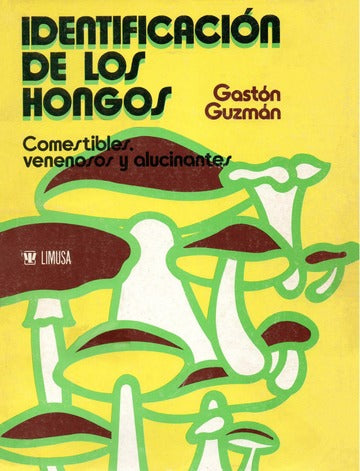
Guzmán, G. (1983). The Genus Psilocybe. Beihefte zur Nova Hedwigia, 74. J. Cramer, Vaduz.
Xalapa, Veracruz, 1932–2016
Gastón Guzmán Huerta was a mycologist, curator, anthropologist, and the most important figure in twentieth-century Mexican mycology. He founded the Fungus Collection of the ENCB-IPN Herbarium in 1955 —the largest and most important in Latin America— and described more than 200 new fungal species worldwide. [2]
His 1983 monograph, The Genus Psilocybe, was the first to systematize every known psilocybin mushroom species —its history, distribution, and chemistry. More than half of the currently recognized Psilocybe species were described by Guzmán and his collaborators. [3]
In 1997 he published Los nombres de los hongos y lo relacionado con ellos en América Latina (The Names of Fungi and Related Matters in Latin America) —the continent’s first ethnonymic inventory of fungi, with more than a thousand names in Spanish and Indigenous languages. He was cofounder and past president of the Mexican Mycological Society and past president of the Latin American Mycological Association.
In 1990 he wrote Wasson and the Development of Mycology in Mexico, critically situating Wasson’s contribution within the context of Mexican mycological science —making clear who built the scientific edifice on which Wasson opened the first door. [4]
The nanacateras: guardians of knowledge
In many Indigenous communities of central and southern Mexico, the women who gather mushrooms are called nanacateras —from the Nahuatl nanácatl (mushroom) and the agent suffix -era. They are the link between the forest and the community: they know each species’ name in their language, on which tree each mushroom grows, in which season, at what altitude, and how to prepare it.
This knowledge, passed from mothers to daughters over centuries, is a sophisticated form of ecological science. Garibay-Orijel et al. (2007) showed that women are the principal transmitters of ethnomycological knowledge and the ones who sustain the greatest diversity of wild-mushroom use in Zapotec communities of Oaxaca. [5]
Simbiosis works directly with nanacateras from six states: Guanajuato, Michoacán, State of Mexico, Puebla, Hidalgo, and Oaxaca —from Otomí, Purépecha, Mazatec, Zapotec, Tlahica-Pjak'óo, and Ñiñu communities. Their participation in the tours is not decorative: it is the source of the knowledge we share.
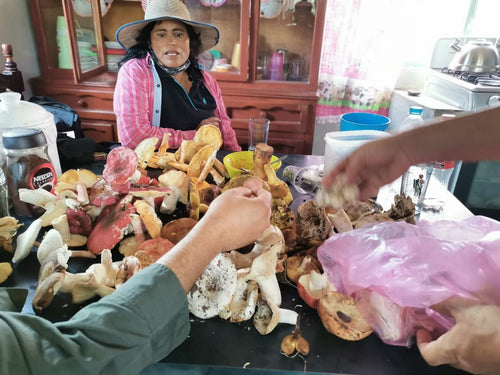
Nanacatera with a harvest of wild mushrooms.
Peoples and mycological knowledge
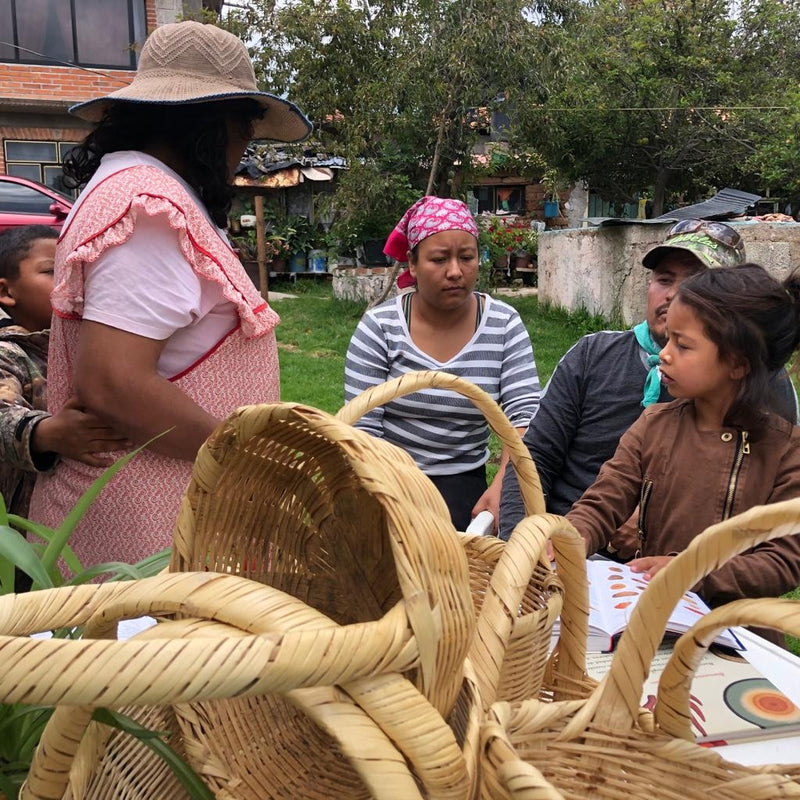
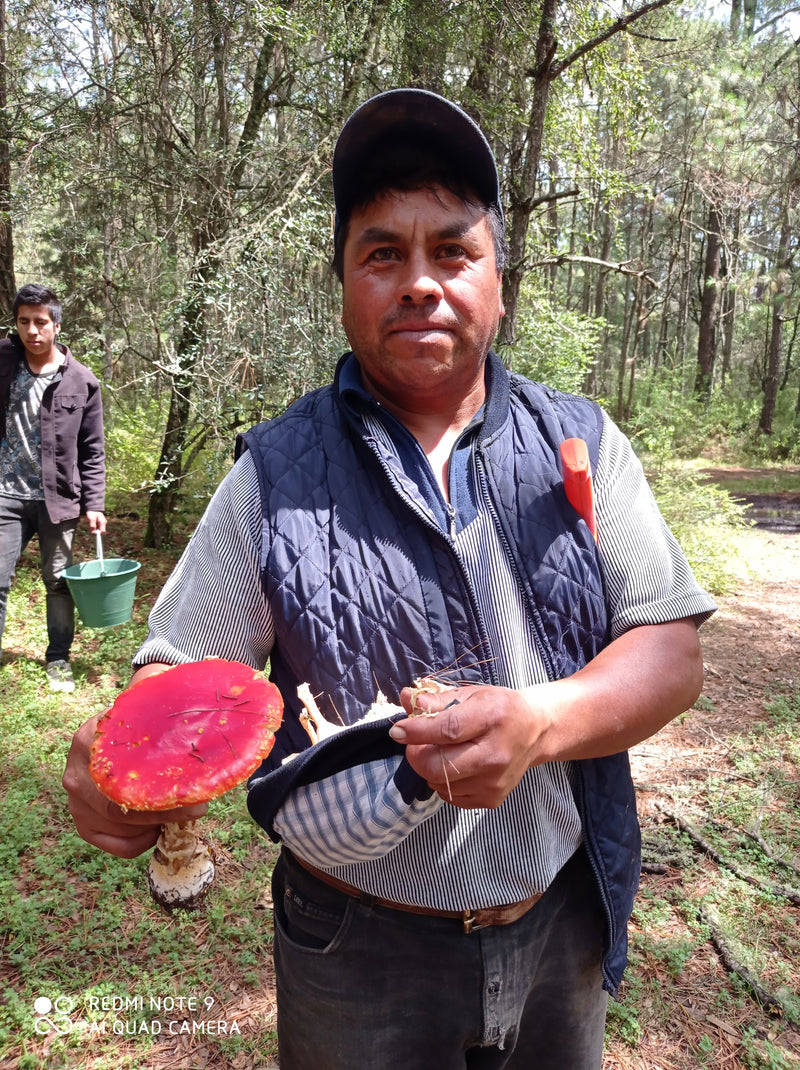
Otomí (Hñahñu)
State of Mexico · Hidalgo · Querétaro
One of the most documented Indigenous mycological inventories in Mexico. They recognize more than 60 edible species with specific names in Hñahñu, including ecological distinctions that do not always appear in the scientific literature. [6]
Purépecha
Michoacán
The lake region of Pátzcuaro and the Purépecha highlands hold deep mycological knowledge tied to their pine and fir forests. Mushroom season is a communal social and economic event. [7]
Mazatec
Sierra of Oaxaca
World-renowned for their relationship with psilocybin mushrooms —Psilocybe caerulescens and Psilocybe mexicana— used in healing vigils (veladas). María Sabina (1894–1985), from Huautla de Jiménez, was the first to open these practices to the Western world through Wasson in 1955.
Zapotec
Sierra Norte and Central Valleys, Oaxaca
Garibay-Orijel (2009) documented more than 80 Zapotec names for fungal species —unprecedented linguistic and ethnobiological work. [8]
Tlahica-Pjak'óo
State of Mexico (Ocuilan, Valle de Bravo)
One of the least-documented Indigenous groups in Mexico. It inhabits pine, fir, and oak forests between 2,200 and 3,400 m above sea level, with exceptional fungal biodiversity.
Ñiñu (Mazahua)
State of Mexico · Hidalgo
Foraging supplements the family economy during the rainy season. They know unique species and preparations that reflect centuries of culinary adaptation to the ecosystem.
The mushroom in the Mesoamerican cosmos
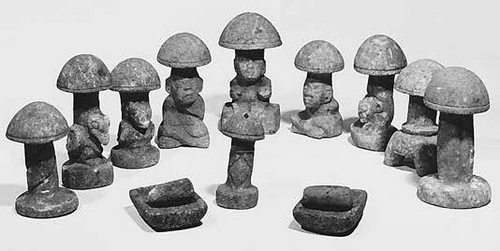
Mesoamerican representation of sacred mushrooms.
The «mushroom stones» —sculptures with a human face found in Guatemala and southern Mexico— date from between 1000 BCE and 900 CE and are interpreted as ritual representations tied to cosmovision and healing.
The Vienna Codex (Mixtec, 14th century) depicts mushrooms in ritual contexts. Fray Bernardino de Sahagún documented the ceremonial use of mushrooms among the Aztecs in the Florentine Codex (16th century), referred to as teonanácatl («flesh of the gods»).
Guzmán devoted much of his work to documenting these pre-Hispanic and colonial references, expanding and correcting Wasson’s initial work with taxonomic rigor and a Mexican perspective. His chapter The Sacred Mushroom in Mesoamerica (1992) is a foundational reference. [9]
Ecology of the fungal forest: why responsible mycotourism matters
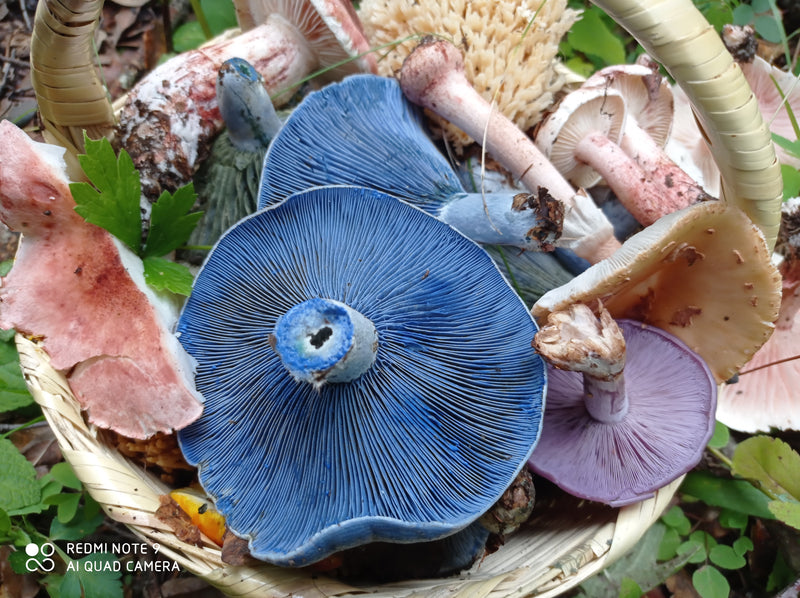

The mushrooms we gather are the fruiting bodies of organisms whose greater part (the mycelium) remains underground. Responsible foraging does not harm the fungal organism when done correctly.
Overharvesting, however, is a real risk. Studies in Mexico and Europe have documented the decline of wild-mushroom populations in areas under high tourist pressure. [10] That is why we operate with small groups, in rotating zones, and with active education about the ecosystem.
Mycorrhizal mushrooms —like Porcini (Boletus edulis) or Chanterelles (Cantharellus cibarius)— cannot be grown in a laboratory because they depend on a living relationship with their host tree. When the forest degrades, these species vanish. [11]
Simbiosis tours: mycotourism with roots
The result of more than a decade of relationships with communities, forests, and chefs —a knowledge network built from respect and genuine curiosity.
- Season: June to October, during the rains
- Small groups: limited spots to protect the experience and care for the ecosystem
- Guide: Arif Towns Alonso, with more than 10 years of field practice
- Guest chefs: we cook what we find with chefs who specialize in ingredients of the territory
- Communities: the nanacateras are an active part of the experience, not set dressing
Scientific references
- Guzmán, G. (1998). Inventorying the fungi of Mexico. Biodiversity and Conservation, 7(3), 369–384. doi:10.1023/A:1008833829473
- Guzmán-Dávalos, L. (2016). Dr. Gastón Guzmán, 50 años como micólogo. Scientia Fungorum, 47. scientiafungorum.org.mx
- Guzmán, G. (1983). The Genus Psilocybe. Beihefte zur Nova Hedwigia, 74. J. Cramer, Vaduz. ISBN: 978-3768254748.
- Guzmán, G. (1990). Wasson and the development of Mycology in Mexico. In: Riedlinger, T.J. (ed.), The Sacred Mushroom Seeker. Ethnomycological Studies 11: 83–110. Dioscorides Press.
- Garibay-Orijel, R. et al. (2007). Understanding cultural significance, the edible mushrooms case. J. Ethnobiol. Ethnomed., 3(1), 4. doi:10.1186/1746-4269-3-4
- Burrola-Aguilar, C. et al. (2018). Ethnomycological knowledge in three communities in Amealco, Querétaro. J. Ethnobiol. Ethnomed. doi:10.1186/s13002-017-0202-7
- Farfán-Heredia, B. et al. (2018). Cultural, economic, and ecological factors in Purépecha markets. J. Ethnobiol. Ethnomed. doi:10.1186/s13002-018-0269-9
- Garibay-Orijel, R. (2009). Los nombres zapotecos de los hongos. Rev. Mex. Micología, 30, 43–61. Scielo
- Guzmán, G. (1992). The Sacred Mushroom in Mesoamerica. In: Miyanishi, T. (ed.), The Ancient Maya and Hallucinogens, pp. 75–95. Wakayama University.
- Martínez-Peña, F. et al. (2012). Effects of forest management on sporocarp production. Forest Ecology and Management, 278, 62–69. doi:10.1016/j.foreco.2012.04.030
- Boa, E. (2004). Wild edible fungi: a global overview. FAO. fao.org
To keep learning
- Guzmán, G. (1977). Identificación de los hongos: comestibles, venenosos, alucinantes y destructores de la madera. Limusa, Mexico.
- Wasson, R.G. & Wasson, V.P. (1957). Mushrooms, Russia and History. Pantheon Books. Archive.org
- Sheldrake, M. (2020). Entangled Life. Random House. merlinsheldrake.com
- Sociedad Mexicana de Micología — Scientia Fungorum: scientiafungorum.org.mx
- Index Fungorum: indexfungorum.org
- MycoBank: mycobank.org
Since 2014, Simbiosis has been building bridges between mycological science,
Indigenous knowledge, and the living forest.